Gary Payton and Shawn Kemp.
Shaq and Penny.
Patrick Ewing and Allan Houston.
Reggie Miller and Rik Smits.
Hakeem Olajuwon and Clyde Drexler.
David Robinson.
Chris Webber.
Alonzo Mourning.
Grant Hill.
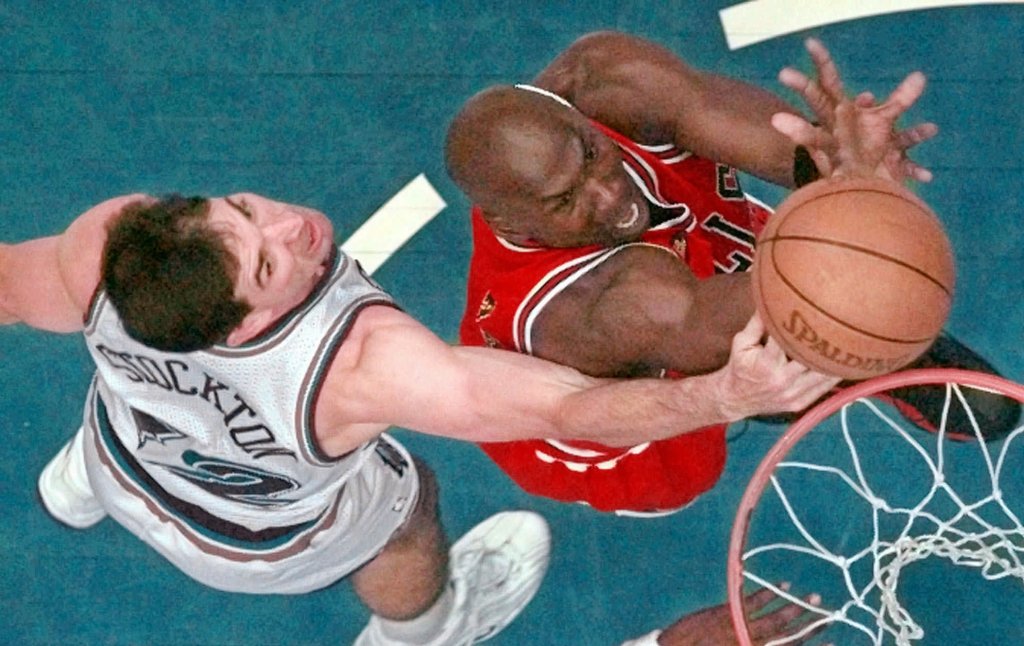
And, of course, Stockton to Malone.
The 1990s of NBA basketball had the stars and the duos spread pretty well across the league. From East Coast to West Coast, many teams assembled talent through the ever-growing drafts and put together winning combinations on the court that displayed a beautiful product of basketball. The Seattle SuperSonics made an NBA Finals appearance, as did the Phoenix Suns, the Houston Rockets, the Trail Blazers, the New York Knicks, the Orlando Magic, and, back-to-back, the Utah Jazz.
Yet.
In a league and moment where parity was arguably present, it didn’t matter.
ICYMI: the “Parity Project” explores the origin of NBA’s storied history of stars and superteams, starting with the 1970s and 1980s. Read Ch. 1 here, with Bird-Magic showdowns setting the stage for MJ’s dominance.
MJ: Heard of him?
Amid the general sense of parity in the NBA during the 1990s, the Chicago Bulls, led by the indomitable Michael Jordan, stood as an exception to the rule. Jordan’s unparalleled skill, his charming charisma, and that epic competitive drive propelled the Bulls to six NBA championships in a span of eight years, creating a dynasty that is widely regarded as one of the greatest in the history of professional sports. Had he not taken a break to play baseball in 1994 and 1995, would the championship count have been larger? The Houston Rockets added to the list of others the Bulls left out? What if the shot over the Jazz wasn’t his last as a Bull, couldn’t they have foreseeably run it back for a four-peat?
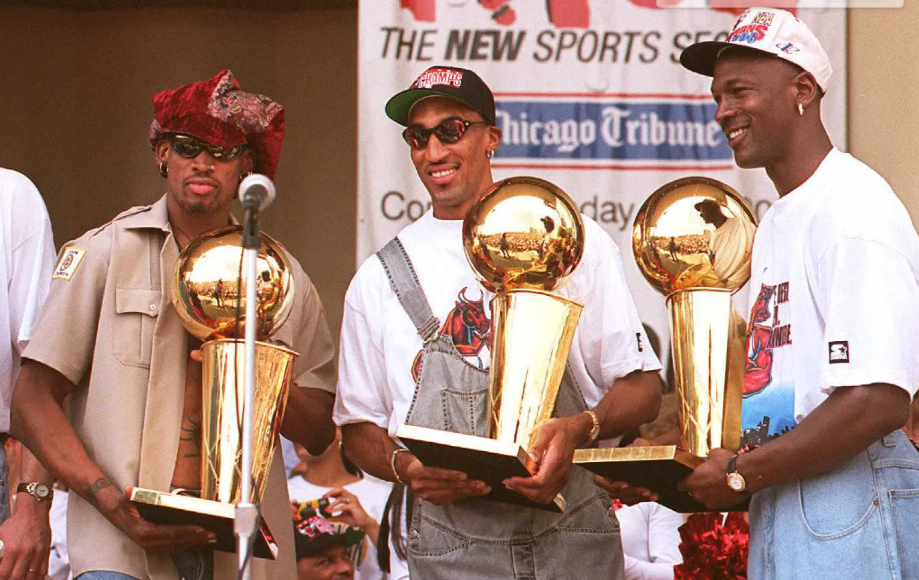
His Airness, alongside Hall-of-Fame teammates like Scottie Pippen and Dennis Rodman, plus legendary coach Phil Jackson, orchestrated a basketball spectacle that captivated fans worldwide. After Larry Bird and Magic Johnson brought popularity to the sport, the Bulls took down the Celtics and Lakers, alongside the Bad-Boy Pistons, as the face of the sport. In due time, the Bulls and MJ would be the face of all sports, a rock band for the ages. It would lead to some of the best basketball ever seen, and ensure the profitability of the league to come.
Yes, the free-throw line dunks and buzzer-beaters were thrilling, and his trash-talk and competitive nature was the stuff of legends, but the success of Jordan didn’t just benefit the wins and losses on the basketball court. Simply, Michael Jordan had a profound impact on the financial success of the NBA and played a pivotal role in shaping the league’s economic landscape, creating a stage for competitive NBA parity to thrive.
MJ Affect: Reshaping the NBA’s Economic Landscape
Let’s break one down; for example, globalization and international appeal. Jordan’s global popularity and success helped propel the NBA onto the international stage. As part of the Last Dance, Jordan’s Netflix documentary released in 2020, President Barack Obama said that Michael Jordan and the Chicago Bulls were not just ambassadors for their sport; they were representing the United States. Additionally, in referring to Jordan’s influence, Obama noted, “There are great players who don’t have an impact beyond their sports; there are certain sports figures who become a larger cultural force.” That was the MJ effect.
With him in their league, “It was an era during which the NBA…opened offices in Hong Kong, Japan and Taiwan; expanded the league into the Canadian markets of Toronto and Vancouver; and held numerous international contests in Europe, Asia, and the Americas.” Jordan and the Bulls would play exhibition games and hold practice in places like Paris or Barcelona and Nike would capitalize on this international market and push shoes all over the world. Jordan’s widespread recognition and appeal transcended borders, contributing to the league’s (or Nike’s) efforts to become a truly global sports brand. As a result, the NBA expanded its reach to new markets, attracting a worldwide fanbase and generating increased international revenue for all teams.
An ESPN article pointed out that the Bulls’ globalization not only affected the ‘90s but still transcends the brand as an international figure to this day. The article starts by making a bold claim, but one that reverberates as truth: the Bulls achieved a level of brand recognition only a select few American sports franchises enjoy around the world. Even if you live across the world, away from screens, or in remote locations, you’re still likely to see the Yankees, the Cowboys, the Lakers. And the Bulls.
ESPN discovered that the Bulls were the third-most popular team in Europe, in terms of Google searches, being the most searched in eight countries. It’s been over 30 years, but they’ve never rebranded their logo or changed their jersey concept and they still use the same intro music at home games. Even when they suck, which has been often in the post-Jordan era, they are among the top five popular teams to follow on social media. “The way I look at it, I believe the Bulls are the first global sports brand, professional sports team in the world,” Michael Reinsdorf, son of team owner, says. “And that’s because of Michael Jordan and our success in the ’90s winning championships.”
MJ Affect: TV and Advertising
For another deep dive into his impact, look at television ratings or advertising opportunities. Jordan’s era in the ‘90s coincided with a surge in NBA television ratings. The intense competition involving Jordan and the Bulls, particularly in the NBA Finals, drew massive viewership. It was a double-edged sword, though, as the Bulls drew viewership and fans, but non-Bulls were a step behind in generating the same traffic. A NYTimes article, published after his (second) retirement, dug into the numbers on how much a Jordan finals compared to those without him (an 18.7 rating compared to 12.3) or that regular season Bulls telecasts were rated with a 71% increase than those ‘other’ broadcast.
Still, networks benefitted from the growing ratings among the ‘other’ and the surging rates of the Bulls. This led to more lucrative television deals. Knowing Jordan wouldn’t play through the duration of the TV contract, NBA and TNT still decided to take the plunge and agree to a 4-year 2.64 billion dollar deal with the league. The NBA’s media partnerships and broadcasting rights saw significant increases in value during this period, setting the stage for the league’s financial growth.
In addition, Jordan would be on your TV screen when basketball wasn’t on. He’d eventually set the stage for other athletes to lead the way in commercial efforts. With Jordan’s likable persona, his charisma extended to his roles in commercials, contributing to his crossover appeal. His partnerships with companies like McDonald’s, Gatorade, and Hanes led to memorable advertisements that went beyond traditional sports marketing. You also can’t forget his iconic Jumpman logo and Air Jordan sneakers that became synonymous with basketball culture.
It had been reported that since Jordan began pitching Gatorade in 1990, sales increased 20 percent to $1 billion. What about Hanes? It increased to $1.7 billion worldwide in 1992 and the company increased its U.S. market share to 30 percent. Annual advertising billings for Mcdonald’s or Gatorade? $50 to $75 million.
More specifically, Chicago saw a lot of growth thanks to MJ. A Chicago Tribune article in 1993 commented that Jordan’s first contract was five years, 4.5 million. With tourism, local advertising, vendors, merchandise, and the people in the seats for games, it was estimated that the Bulls got a 22,000 percent return on their investment. “It’s almost incalculable,” said John Skorburg, chief economist for the Chicagoland Chamber of Commerce. “But I wouldn’t be surprised if it approached a billion.”
In 1993.
And if Jordan wasn’t on your TV screen or billboard, well he was in your movie theatre with Space Jam (in 1996) where he teamed up with the Looney Tunes characters for a game of basketball against some alien monsters who were stealing NBA talent. Sound a little wonky? Who cares! It was still a commercial success and showcased Jordan’s crossover appeal beyond sports.
In Space Jam, Patrick Ewing, Larry Johnson, and even Shawn Bradley are on screen, too. Some of the best Gatorade commercials with MJ? What about the ones that involved other athletes, like Mia Hamm of USA womens soccer or Bo Jackson and Derek Jeter of MLB? During the ‘90s, MJ was a highly sought-after figure for commercial endorsements, but he was often sharing the spotlight with other notable athletes in various advertising campaigns. These collaborations not only showcased the star power of Michael Jordan but also demonstrated the cross-sport appeal of these athletes. With the blend of humor, competition, and a sense of camaraderie, advertisers found a new way to engage their audience through the use of professional sports.
MJ Affect: Just Made Sports Better
Jordan opened the door for other athletes, from all sports, to be featured more prominently after he burst onto the national and international stage with enormous success in advertising and marketing. This trend would only continue to increase for stars of today to profit this way, all to way to the latest in collegiate sports with Name, Image, and Likeness deals giving college athletes an income, sometimes in the millions.
Jordan’s impact extended beyond the court, transcending basketball to become a global cultural phenomenon. These two examples, and many more that could be published, illustrate how Michael Jordan’s influence extended well beyond the basketball court, shaping a cultural landscape for his name and his brand, but also the NBA and all teams involved.
The short story, MJ made sports better.
The shot over Ehlo and Cleveland.
The shrug against Portland.
The dunks on Patrick Ewing.
Withstanding the hurricane against The Glove.
And, of course, the steal and shot over Utah.
It didn’t matter much who Jordan played against as he would become the winner more often than not. His greatness can’t be matched, going 6-0 in the NBA Finals while in his prime. But he brought the best out of others, bringing the competitive nature of basketball to its peak.
The 1990s in the NBA was a decade marked by a unique sense of parity, even as Michael Jordan and the Chicago Bulls dominated the basketball landscape. While Jordan’s Bulls secured six championships in the ’90s, the league as a whole witnessed a competitive balance that extended beyond a single team’s dominance. The era featured formidable contenders such as the Detroit Pistons, Houston Rockets, and Los Angeles Lakers, each contributing to a dynamic and unpredictable league. Teams like the Portland Trail Blazers, Utah Jazz, and Phoenix Suns consistently challenged the Bulls’ supremacy, showcasing the depth and competitiveness of the NBA during this period.
Despite the Bulls’ undeniable greatness, the ’90s was an era where multiple teams and stars played pivotal roles in shaping the narrative of the league, fostering a sense of parity that defined the decade as more than just the reign of the Chicago Bulls.
Make a one-time donation
Choose an amount
Or enter a custom amount
Your contribution is appreciated.
Donate Steve Godfrey Writes