On July 31, 2022, legend Bill Russell passed away at the age of 88. His NBA resume is full of accolades and accomplishments, but his lasting life legacy is the more impressive list.
Subscribe to get access
Read more of this content when you subscribe today.
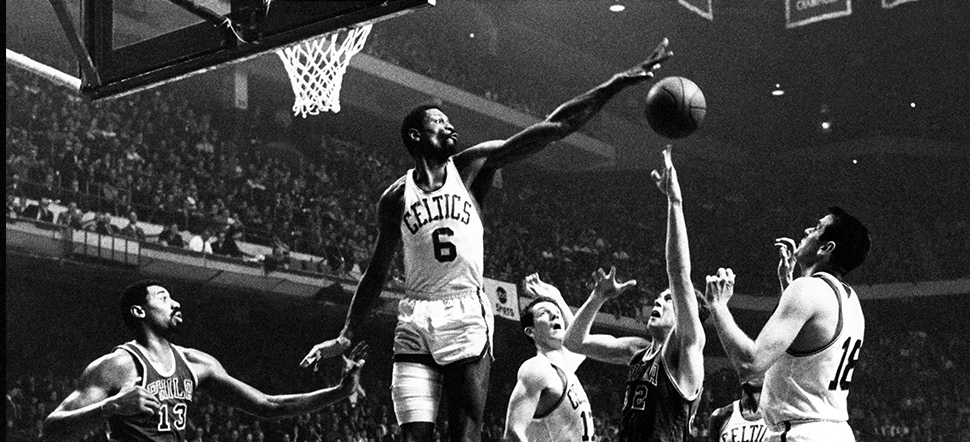
Russell was selected as the second overall pick in the 1956 NBA draft. Over the next 13 years of his professional basketball career, he won 11 championships with the Boston Celtics; a record that won’t be touched. By doing so, many have claimed Russell as the most accomplished basketball player, the most accomplished athlete, and the biggest winner in all of sports. In rings culture, rings matter: 11 out of 13 is hard to argue.
He averaged over 20 rebounds a game in 10 of his 13 seasons, alongside double-digit point averages in 12 of those 13 seasons as well. He was an NBA All-Star 12 times and won the league’s MVP award five times. The games biggest star was Wilt Chamberlain, a man who could score at ease and once bucketed 100 points in a single game, but it was nearly always Russell who would best the supposed best big. He’d get in his head before the matchup, and then outwork Wilt in the little things to get his team to best the Lakers or 76ers in most games. In fact, they clashed for a decade in which Russell beat Chamberlain in the playoffs in seven out of their eight matchups. Wilt got the headlines but Russell got the wins; he was never the biggest star, but he played with the biggest heart – and it mattered.
To state the obvious, I never saw Bill Russell play basektball. I’ve only seen clips and highlights, or read about his legacy and browsed his stats. I know he was prolific on the board, rebounded the ball like a man possessed. I know he was a defensive specialist, but that stats for blocks and impact are harder to come by and track. I know he was a scorer, too, on the block and with a hook that was hard to defend. 6-foot-10 with muscles naturally buldging, I know he was a force; plus, add in his heart, motor, mentality, and relentless passion, dedication, and energy to win. C’mon.
There is a rumor that his favorite modern pro was Tim Duncan. I don’t need to see the tape; hearing that tells me exactly the kind of basketball player Russell was. In a one-on-one conversation, the two shared sentiments about their game and careers. “It’s kind of eerie, the similarities we’ve had in our lives and in our careers,” Duncan told Russell in 2009. “We have so much in common. I feel very flattered (to be compared with you),” Russell replied. Later, he admitted Duncan was his favorite player. “You’ve played hard, played smart and won championships.” I feel like I got a glimpse into Russell’s impact on the hardwood by watching TD’s unstoppable bank shot, his timing for blocked shots, and how all he cared about was winning, so all he did was win.
In 2009, then commisioner David Stern decided that the NBA’s greatest winner would be the namesake for the NBA Finals MVP trophy. For it, Stern said, “Who better to name this prestigious award for than one of the greatest players of all time and the ultimate champion.” Since then, on the biggest stage of the biggest games amongst the biggest stars, it’s visibly been Russell who stands out biggest of to give out this trophy to those who have worked the hardest, played the best, and willed their team to the elusive and coveted NBA championship.
Off the court, Russell was an active force towards Civil Rights as he marched with Martin Luther King, Jr, supported Mohammad Ali in his boxing match against the Vietnam War, and was a friend for barrier-breaking Jackie Robinson (evetually serving as his pallbearer).
Racism was a constant battle in his life, bigger than a Wilt or a Lakeresque opponent. When a kid, his family moved from the south to California so they could escape the threats of lynchings. In his professional hometown of Boston, his own team’s fans broke into his home, destroyed trophies and personal belongings while spray-painting slurs across his walls and taking shits on his bed. He faced injustice as a professional athlete, as a father, and as a man living in America from age 10 to 80. As you would imagine, his stories are harrowing. One of the hardest things I read from him was, “None of my medals or championships could shield my children from White Supremacy.”
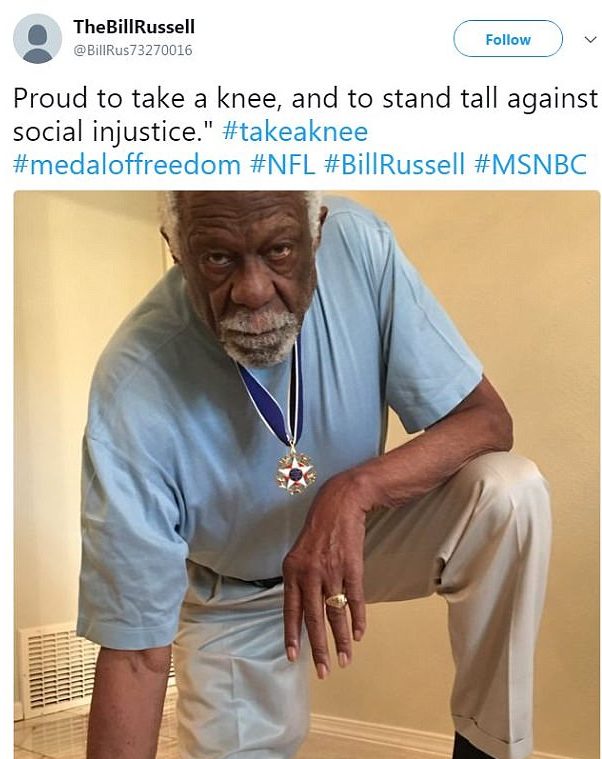
Yet, instead of breaking down he continue to break out against this norm. When you look up his biography or title or read wikipedia on the guy, one of the first things you’ll learn is that he was a civil rights activist. Before LeBron James and others stood up against the idea to “shut up and dribbling,” it was Russell who stood alone during a moment of history and a generation that just can’t feel real. We read of that time in our history books and watch it from our documentaries – he lived it. And then lived to see the continual battle as it extended to 1992 and Rodney King riots, or 1994 and Violent Crime Control and Law Enforcement Act, or 2012 and Trayvon Martin, or 2020 and George Floyd. It’s why he took a knee in a viral Instagram post to support Colin Kaepernick because he had been taking knees since his 20s.
As a kid, his mother went on to tell him that I should never pick a fight with anyone, but that he should always finish the fight he was in. Physically, sure, but metaphorically, too as he fought the battles of racism and injustice until his recent passing, hoping he could closer and nearer to its finish on behalf of those underrepresented in all capacities.
At the time of his death, current NBA commisioner Adam Silver highlighted that fight. He said, “Bill stood for something much bigger than sports: the values of equality, respect and inclusion that he stamped into the DNA of our league. At the height of his athletic career, Bill advocated vigorously for civil rights and social justice, a legacy he passed down to generations of NBA players who followed in his footsteps. Through the taunts, threats and unthinkable adversity, Bill rose above it all and remained true to his belief that everyone deserves to be treated with dignity.”
Case in point: Russell was invited to the 1954 all-college tournament for his exceptional play during his college career at San Francisco. When he and others arrived in Oklahoma City, they were denied a room. Russell didn’t act, and the group found vacant rooms at a nearby college, and played their game. Years later, in a 1961 exhibition game in Lexington, Kentucky, a restaurant refused to serve him and his Black teammates, so he told the coach it was time to pack up and leave town, without playing the game. They did. “I said it was because it was important to me that everybody, everywhere, knows that the Black players are deciding they’ll stand up for themselves.” He added, “we’ve got to show our disapproval of this treatment or else the status quo will prevail. We have the same rights and privileges as anyone else and deserve to be treated accordingly. I hope we never have to go through this abuse again. But if it happens, we won’t hesitate to take the same course of action.”
Case in point: He joined the NAACP.
Case in point: The “Cleveland Summit.”
Case in point: After the assassination of activist Medgar Evers in Jackson, Mississippi, Russell called the family and asked how he could help. Come to town, run a basketball clinic, and talk about what is important. Fearing for his life and against his wife’s wishes – cars followed him, men flashed guns at him along the streets, his door rattled at night, threats over breakfast at the diner – he ordered an airplane ticket and helped a grieving community find solace in basketball, teamwork, and a cause for justice as he led their first ever integrated basketball camp.
There was a basketball magazine I was obsessed with as a kid – SLAM. Covers only featured the stars, and the images were iconic.
As the Black Lives Matter was growing in the USA, it was also growing inside the NBA as its stars, like James, were speaking out. Carmelo Anthony was another strong voice, so it was no surprise to see him grace a special edition issue dedicated to BLM with his son in matching black hoodies. Within that monumental issue, current and former stars wrote first-person essays with their experiences with injustice and their pursuit of equality. The headlining essay was written by Russell.
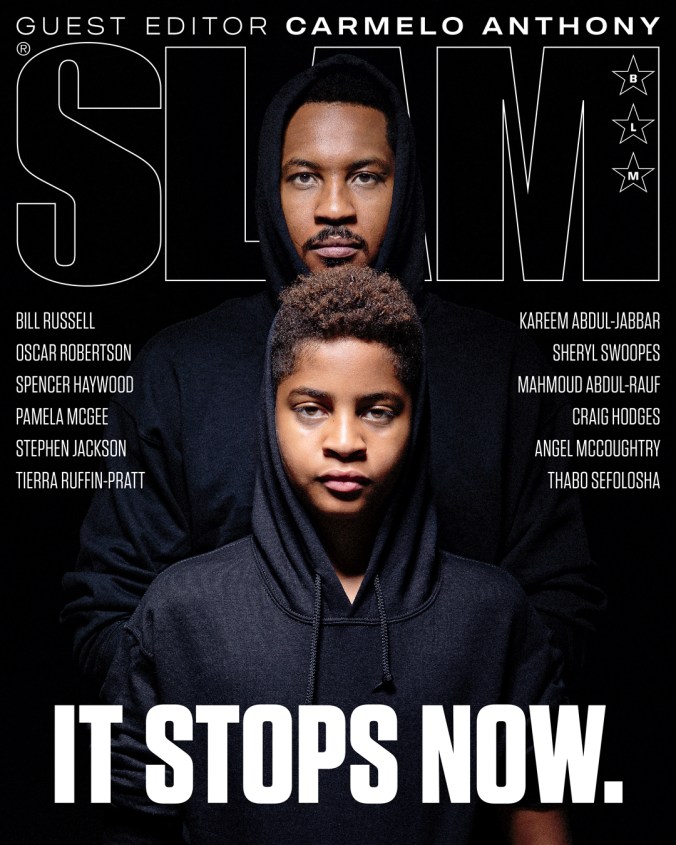
I remember reading that essay when it originally came out, but I was brought back to it with Russell’s death. His experiences, as a kid and an adult, were heartbreaking. His perspective, however, were full of life lessons that provided strength for endurance and motivation for change. Something that I loved was his analogy of comparing racism in the United States to dust on a rug. He wrote:
“But what can we do about it? Racism cannot just be shaken out of the fabric of society because, like dust from a rug, it dissipates into the air for a bit and then settles right back where it was, growing thicker with time.”
He has another first-person essay that was published in The Boston Globe around the same time as his SLAM magazine narrative (in fact, he references and links the article within his SLAM essay). Taking the two definitons of strange – uncommon and out of the ordinary versus uncomfortable and ill at ease – he shares which definition best fits examples within recent US History. Much like his playing career, the whole thing has power, emotion, and heart. I can’t recommend it more.
In 2011, then-President Barack Obama awarded Russell with the prestigious Medal of Freedom award, essentially for being a winner on and off the court.
Talking about his basketball accomplishments, Obama shares a story of Russell, regularly, being asked if he was a basketball player. In response, Russell would say, regularly, something along the lines “That’s what I do, that’s not who I am.” Describing who he was, Obama praised Bill Russell the man as someone who helped success come for others, while constantly paving the roads so more success could follow for others, too.
Russell paved roads by being a teammate. He could score, but others could score better and in more ways. They’d run a play called “6,” to get Russell an easy bucket. More times than not, he would dish out and get a teammate an easier score. He could run a fast break, he could dribble, but he knew everyone needed a role. In fact, when accepting his namesake for that NBA Finals MVP honor, Russell deflected, “I want to thank my teammates because we played a team game quite well. I accept this for my team, and my team included our coach, Red Auerbach, and all my teammates over the years. This is quite flattering.”
There’s a popular story about Russell, recently drafted and a rookie, scouting his team from the sidelines at his first few practices. He ended up doing this often. The reason was so that he could better play to their strengths. He saw who had what role and who was good at what, but he was also looking to see where the holes and weaknesses were. That would become his job. He could do anything on the basketball court, but what did the team need? And from season to season, that was his vision. It ended with a lot of winning.
Bob Cousy was Russell’s point guard for seven seasons (six championships together in case you were curious). Cousy has been credited with running the first fast break in the NBA. He pushed pace for that time period, and dribbled in ways that were uncommon. As this began to take flight, Russell asked his point guard, where do you want the ball? When I get a rebound, where can I flip it to you so you can just go and get this thing going? They picked a spot, intentionally practiced and ran it a couple times, and then it was just second nature. An opponent would hoist a jumper, it would bounce off the rim or the backboard, and boom, Russell is rising to the sky to snare the ‘board. On his way down, in a half second, he’d turn and snap the ball like a catepolt to Cousy. The fast break was born, nearly indefensible. An up-close local writer during their time, Gary Pomerantz, said, “They were, in many ways, the ultimate teammates.” Elaborating, he said, “They were both murderously competitive. And, very quickly, the Celtics emerged as a force to be reckoned with.”
Countless other teammates have shared stories about Russell knowing them individually. He knew their talents, strengths, and weaknesses as it pertained to the basketball court and basketball game, but he also knew their moods and personalities so he could connect to them as a person. When it was time for motivation, or to give them space, he knew them well enough to be the man for them. This insight makes it no surprise that Russell was hired as the successor to legendary Celtics coach Red Auerbach. Russell was the player-coach for the Celtics for his last three seasons in the NBA. Sure, he was the first black head coach in any of the professional sports in the United States, but what did that matter? He won two of three championships in that role.
(The last was especially tasty, the stories say. The Celtics were the fourth seed and barely alive as they entered the playoffs. Russell was old with many miles on his worn-and-heavy body. Mentally, he was constantly speaking up against racism and injustic, plus was serving as a coach and heavily managing that role. As they made it to the playoffs, they found steam. They beat Philly 4-1 in the first round, then bested New York, led by Willis Reed and Walt Frazier, 4-2 to make it to the NBA Finals. Wilt Chamberlain – remember him? – had been traded from the 76ers to the Lakers that season. He awaited Russell for what would be a classic finale to their matchups and rivalry. And it was a doozy! LA took game one by two points, then won game two by six points. Boston evened the series by winning the next two at home, with Sam Jones hitting a jumper over Chamberlain at the buzzer to give the Celtics the 89-88 win in game four. The teams then each won at home to reach a decisive game seven that would be played in Los Angeles. These Lakers were loaded, mind you, with Jerry West scoring so many points, Eligin Baylor as a more than capable number two, plus, PLUS the monster that was Chamberlain. As Russell took the court to match that talented trio, he looked up and noticed balloons netted together in the rafters. Championship celebration materials. Taking it further, flyers were placed in every seat stating: “When, not if, the Lakers win the title, balloons will be released from the rafters, the USC marching band will play ‘Happy Days Are Here Again’ and broadcaster Chick Hearn will interview Elgin Baylor, Jerry West and Wilt Chamberlain in that order.” Russell saw all of this, passed it around his locker room, and then let that fuel everything left in him. He only scored six points that game, but played all 48 minutes and snared 21 rebounds. The Celtics outscored the Lakers 31-17 in that final quarter, with Russell valiantly, and impactfully, huffing and puffing to the finish line, while Chamberlain did not. The Celtics won by two, 108-106. No balloons were dropped.)
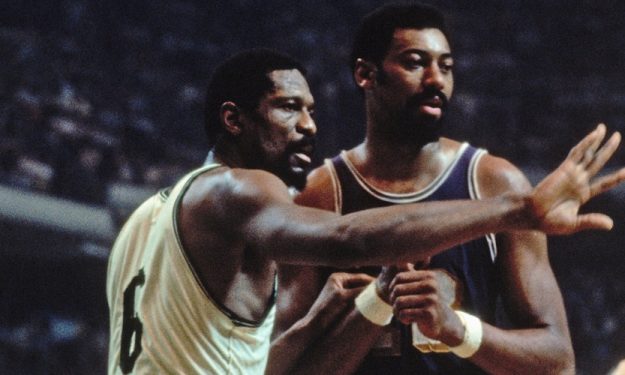
Remember, all Russell did was win. He had two NCAA championships, an olympic gold medal, those 11 out of 13 rings (including eight straight). Rick Reilly (my first favorite sports journalist) revealed in The Washington Post that “in his college, Olympic, and NBA career, he played 21 winner-take-all games.” Noted by Reilly, he went 21-0. On top of that, could’ve been special in the long jump and high jump, led the league in rebounds, grabbed 51 rebounds in a single game, and was the first player to average more than 20 rebounds per game for an entire season.
Yet.
Yet, all would say and repeat time and time again was, “The most important measure of how good a game I played was how much better I’d made my teammates play.” So, he sought them out, knew them personally, and helped lead his teams to function, literally and holistically, as a team.
If there were to be a thesis about this post, it would be that Russell’s legacy, etched in stone as he goes on to his hereafter, was that of a winner. His key to that success was by valuing the team and teamate. If an addendum was to be added to said thesis, it would be that Russell was a winner of life, fighting for the team and teammate.
Thinking about Russell the basketball player and Russell the man, I think a characteristic and theme crosses into both boundaries: that of a teammate who puts his heart for the team. That team could be the Boston Celtics and the NBA community or it could be Civil Rights and activism; for either, he was a teammate and ally first and foremost. It’s for these reasons he loomed large and inspired many: among all the shining stars of the sky – athletes, celebrities, presidents, and every in between in the past 80 years, it was the figure of Bill Russell that stood out as legendary figure in the constellations defined by heaven.
 Steve Godfrey Writes