Less than 36 hours after defeating the Oklahoma City Thunder to win a first-round playoff series, the Utah Jazz were then welcomed into Houston with a sound defeat, 110-96.
It was as close to a scheduled loss given the time off for Houston, Utah wanting to celebrate and enjoy its series win (Donovan Mitchell admitted he stayed up quite awhile afterwards watching The Office—man, I love him), the travel for Utah, and the nature of the opponent and its home court. Yes, tough situation, but the Jazz did outscore the Rockets 57-46 in the second half after getting blitzed 64-39 in the first stanza.
Houston is good and the Jazz are the underdog for good reason. However the loss, the score, and the opening tilt was instrumental in outlining just what the Jazz will need to do in order to make this second round competitive.
Houston is no Thanos, but the Jazz are close to an Avenger’s rag-tag of superheroes against a dominant foe. If there are 1-in-14 million odds for Utah to pull off the upset, they’ll need to start with this Honey-Do list.
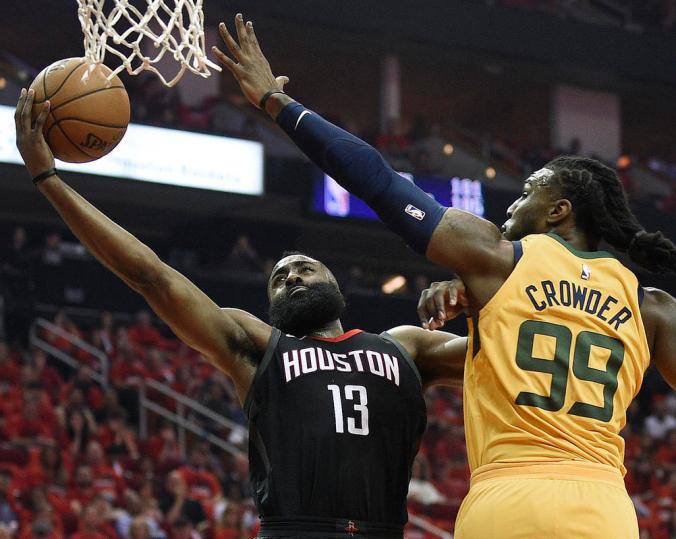
Houston Rockets guard James Harden (13) drives to the basket as Utah Jazz forward Jae Crowder defends during the first half in Game 1 of an NBA basketball second-round playoff series, Sunday, April 29, 2018, in Houston. (AP Photo/Eric Christian Smith)
ICYMI: Don’t let the stats fool you, the Jazz wrote their own Russ Rules to slow Westbrook down in the first round. How? No really, how? Read here.
BONUS: Two Jazz players are in the conversation for end-of-season awards and it’s time to make their case. For Rudy Gobert, is he an All-NBA center and Defensive Player of the Year nominee or did injuries deter the legitimacy of his candidacy? For Donovan Mitchell, people outside of Utah may wonder why we are infatuated with this guy, but he healed our heartbroken souls of 2017 and is giving us a glimpse of excitement, stardom, and passion we haven’t had in awhile.
The Dribbles
Before going in-debth on the keys to the series, here are some questions worth pondering.
- Can Alec Burks keep it going? Given that Ricky Rubio is out, the Jazz need another ball handler. Given that Houston scores a lot, the Jazz will need more offense. Can Burks provide solutions to both thoughts? In game one, Burks was the only player with a positive +/- in the first half, except that it was a neutral, +0. By the end of the game, the Jazz were four points better with Burks on the floor in his 17 minutes. Remember: before the Game Six breakthrough in OKC, Burks was only averaging 1.9 minutes/a playoff game. He is in line for more, but will it be Good Burks or Bad Burks?
- Take advantage of foul shots. The easiest way to score points is with the freebies. Points are going to be hard to come by for Utah so they should get the foul line and then connect when they get there. In Sunday’s loss, the Jazz left nine points at the line as they went 13/22 from the charity stripe. That needs to be addressed to help the Jazz stay in ball games.
- What lineup combination will be best? Houston deploys shooters and utilizes space and switches to keep their offense humming and their defense decent. How can the Jazz match that? Guard that? Destroy that? In the playoffs thus far, the lineups with Rubio are high on the plus side, so who will they use to replace that while keeping up efficiency, especially vs Houston’s potency?
- Speaking off lineups, what about Dante? Looking at the chart below tracking 5-man combinations in the playoffs, the six minutes with Royce O’Neale and Exum (instead of Rubio and Mitchell) is +21 which is a surprising, but encouraging, number. Those two will be called on to replace Rubio, so can they do so in this series?
| Net | Net | Net | Net | Net | Net | Net | Net | Net | Net | Net | Net | |||
|---|---|---|---|---|---|---|---|---|---|---|---|---|---|---|
| Rk | Lineup | MP | PTS ▼ |
FG | FGA | FG% | 3P | 3PA | 3P% | eFG% | AST | STL | BLK | TOV |
| 1 | R. Gobert | J. Ingles | J. Jerebko | D. Mitchell | R. Rubio | 6:31 | +33.3 | +6.7 | -20.0 | +.135 | 0.0 | -13.3 | +.267 | +.149 | -6.7 | +6.7 | -13.3 | +6.7 |
| 2 | D. Favors | R. Gobert | J. Ingles | D. Mitchell | R. Rubio | 75:47 | +29.0 | +11.5 | +6.4 | +.098 | +4.3 | +0.6 | +.140 | +.117 | +8.5 | -0.9 | +0.5 | -1.7 |
| 3 | J. Crowder | D. Favors | J. Ingles | R. O’Neale | R. Rubio | 6:26 | +23.4 | -0.6 | -1.3 | .000 | +14.3 | +40.9 | +.286 | +.100 | +19.5 | +3.9 | +9.1 | -13.0 |
| 4 | J. Crowder | D. Exum | R. Gobert | J. Ingles | R. O’Neale | 6:29 | +21.4 | +15.5 | -19.0 | +.375 | -11.9 | -17.9 | .000 | +.333 | +3.6 | -1.2 | 0.0 | +17.9 |
| 5 | J. Crowder | R. Gobert | J. Ingles | D. Mitchell | R. Rubio | 19:15 | -2.5 | +2.5 | -7.5 | +.063 | 0.0 | -5.0 | +.031 | +.066 | +7.5 | 0.0 | +5.0 | -2.5 |
| 6 | J. Crowder | D. Favors | R. Gobert | D. Mitchell | R. Rubio | 17:20 | -2.9 | -1.2 | -10.6 | +.048 | -3.0 | -9.1 | -.008 | +.038 | +2.3 | -8.0 | +0.1 | +10.5 |
| 7 | J. Crowder | D. Exum | D. Favors | D. Mitchell | R. O’Neale | 9:05 | -22.5 | -13.2 | +5.6 | -.161 | +5.0 | +9.4 | +.083 | -.138 | +4.4 | -5.0 | +5.6 | +4.7 |
| 8 | D. Exum | D. Favors | J. Ingles | J. Jerebko | R. O’Neale | 6:31 | -40.0 | -8.3 | +10.0 | -.139 | -21.7 | -16.7 | -.350 | -.264 | -3.3 | -8.3 | 0.0 | +16.7 |
| 9 | J. Crowder | D. Exum | D. Favors | J. Ingles | J. Jerebko | 10:15 | -47.6 | 0.0 | +23.8 | -.147 | 0.0 | +19.0 | -.250 | -.172 | +9.5 | +4.8 | -9.5 | -4.8 |
| 10 | J. Crowder | R. Gobert | D. Mitchell | R. O’Neale | R. Rubio | 23:40 | -64.7 | -21.5 | -6.4 | -.227 | -12.0 | +8.7 | -.444 | -.296 | -3.8 | -10.4 | +1.9 | +18.6 |
And last, but not least: 5. James Harden is good. Yup, not a question but a statement. The future MVP is a really good offensive player, utilized perfectly by Coach D’Antoni in the perfect style for his skills. He shoots 10 FTs a game and is really annoying at initiating contact with a defender on a jump shot, but I still must concede his greatness. Can the Jazz slow it down? Probably not.
- how to stop james harden
- step 1: do literally anything because it doesn’t matter
step 2: hope he misses
step 3: wait for series to end— Layton Shumway (@theshums) April 29, 2018
Half-court Heave: Bigger Questions to the Series
Now let’s dig into some cake like a baby on their first birthday and analyze some bigger keys to helping Utah out in this second-round match-up.
1. Limit HOU Transition by limiting UTA turnovers
Prior to game one, the voice of the Jazz tweeted his thoughts on what Utah would need to do to steal some games. His first item of business? Limiting the turnovers which keep the Rockets in check from transition. The Rockets like to run and gun and it wouldn’t help if the Jazz cough up freebies along the way, leading to easier buckets.
On Sunday afternoon, the Jazz gave away the ball 18 times, resulting in 14 points for the Rox. Houston, on the other hand only had 15 turnovers, but the Jazz took advantage with 22 points of their own.
The reason for concern is that the Jazz lead all teams in the playoffs with 109 turnovers this postseason. Houston, on the other hand, is the opposite, second best, with 57 turnovers. Like Locke suggests, these trends need to reverse for Utah to have success.
About to tip off for the Western Conference Semi-Finals
Utah Jazz v. Houston Rockets
Keys for the Jazz
1) No turnovers to limit Rockets transition
2) Keep the ball moving. If ball stops sign the Rockets switching defense is having its impact
3) Limit three point attempts— David Locke (@Lockedonsports) April 29, 2018
https://platform.twitter.com/widgets.js
2. Contain and Deploy the Three
Houston took Golden State’s three-and-D revolution and amped it up during the 2017-2018 NBA season. Through 82 games of the regular season, the Rockets put up 3,470 threes, connecting on 1,256 or 36%. The attempts were out of the roof, almost 500 more than second place. Since April, Cleveland has taken 227 threes this postseason, in seven games, while Houston has put up 217 in five games where they’ve hit on 35%.
Sunday afternoon was what you would expect from the team at home after rest: everyone was hitting and it was raining deep. While 53% may not be sustainable, putting up 32 attempts is exactly what Houston’s offense wants to do. They hit on 17 of the bombs, getting deep buckets from six players: Harden (7!), Chris Paul, P.J. Tucker, Trevor Ariza, Luc Mbah A Moute, and Gerald Green. Notice I didn’t list their bench specialist, Eric Gordon, who missed both his attempts, or stretch four Ryan Anderson, who only played nine minutes. The team can light it up, from all positions.
Utah is pretty good with the three, too, but Sunday couldn’t keep up. Utah shot 32% (average 35% in the postseason so far) on 22 attempts, but if you take away Jae Crowder the numbers look disgusting (Crowder went 5/7). The Jazz average 10 makes a playoff game, so jumping to the mean would have given the Jazz an extra nine points which would have been gladly appreciated. What’s promising is that is doable and expected as Joe Ingles and Mitchell can all knock down a higher, or just normal, percentage.
.@CJC9BOSS with his fifth three-pointer of the game ????? pic.twitter.com/qLsUhFC4ey
— Utah Jazz (@utahjazz) April 29, 2018
https://platform.twitter.com/widgets.js
3. Backcourt vs Backcourt
It’s an All-Rookie vs an All-World backcourt battle in this showdown with Donovan Mitchell and Royce O’Neale on one side and two of the best guards in the NBA, James Harden and Chris Paul on the other.
Against Minnesota, Harden and Paul combined for 48 points and 14 assists as both shot above 40% from the field and above 30% from deep.
It’s a really tough matchup, especially with Rubio out, which is why O’Neale may be the X-Factor for the Jazz to have a chance. We know what Mitchell can do, but what about the other rookie?
He can play good enough defense to contain—not shutdown—Harden and plays (kinda) like this are exciting.
James Harden tried to shake Royce O’Neale. It ended up looking like this: pic.twitter.com/orQAVQzNAV
— “Playoff SLC D” (@slcdunk) April 29, 2018
https://platform.twitter.com/widgets.js
The defense is why he is starting, but the defense isn’t the issue in question. He’ll need to step up his offensive game to make a dent. Against OKC, O’Neale only played 18 minutes a night but put in five points on 42% and 38%. The problem was, that’s on three shot attempts a game, which will now increase given his bigger role.
Those percentage numbers are good, but can they continue in a larger sample size? Sunday afternoon, O’Neale only took more shots, going 2/5 and 0/2 from deep. I love his hustle and his defense, but we desperately need those threes to drop for the Jazz to keep pace.
Just realized Utah’s probably going to start an all-rookie backcourt (Donovan Mitchell and Royce O’Neale) against one of the most talented backcourts ever assembled (Chris Paul and James Harden).
— Andy Bailey (@AndrewDBailey) April 29, 2018
4. Oh man, all the Bigs stuff,
Specifically Can the Bigs guard the Pick-and-Roll?
Can the Jazz’s Mountain Peaks down low handle the PnR against either Harden or Paul, especially when screen and rolled with Clint Capela? That play by Houston has been nearly automatic as the guards are so lethal to score from anywhere, but both guards are some of the smartest thinkers in the league AND best passers, making the play nearly unguardable when you put that all together in fractions of seconds. When Capela rolls, it’s an alley-oop.
ALL THE WAY ?
? 98
? 83
⏰ 5:52 pic.twitter.com/0K0QCKNpg1— Houston Rockets (@HoustonRockets) April 29, 2018
Or, what about on switches, can the bigs guard the three?
A valid question, that resulted in a lot of this on Sunday:
C
P
3
? pic.twitter.com/GmugqzkAB5— Houston Rockets (@HoustonRockets) April 29, 2018
https://platform.twitter.com/widgets.js
It starts with Rudy
Rudy Gobert will need to show his value on the offensive side of the ball (and take more than four shots like he did in game one) but will also need to prove (again) his DPOY candidacy by playing D on the perimeter and in space.
Prior to the OKC series, Jonathon Tjarks of the Ringer pointed out how difficult that was for Gobert vs Steph and the Warriors last postseason and noted: “if it starts to become a trend this postseason, there may be a ceiling to how good a team built around Gobert can be.” Gobert was able to stay on the court and in most match-ups vs Paul George and Russell Westbrook of the Thunder but now must do the same against Harden and CP3, which actually may be a little tougher.
Case in point: on an early switch in the first quarter, Gobert was out at the three-point line matched up against the future MVP. Harden blew by him, easily, and had the layup for two. Because the Rockets stretched the floor to get Gobert out on the perimeter, it meant the lane and hoop was unprotected so one move allows the hoop to be wide open, as the play below suggests.
“La Barba” @JHarden13 entrando en calor ??#Rocketspic.twitter.com/GAiXom0wnf
— NBA MÉXICO (@NBAMEX) April 29, 2018
And then Derrick
Favs was the unsung hero in the first round, but finds himself in another favorable—so critical—match up. Can Favors step up like he did in the series vs OKC? The Rockets like to go small, starting P. J. Tucker at that Power Forward position. Big Ryan Anderson pops off the bench and provides the stretch-four shooting the Rockets thrive on. On paper, Favors can take both of those guys in the post, but can he chase either of them around the perimeter on D?
The answer is probably not, which means he must maximize his offensive possessions to give the Jazz points on the mismatches. As well, Tucker and Anderson aren’t the best defenders, so perhaps Favors could get either in foul trouble to disrupt the Rockets’ rhythm and rotations?
By the way… for what it is worth.. Anderson had a worse defensive rating this season that Melo.. so if they play Anderson, UTA goes at him every play offensively imo. https://t.co/LaAz37Cf2l
— Spencer Wixom (@JazzJargon) April 28, 2018
https://platform.twitter.com/widgets.js
Add It All Up
I’m not waving the white flag, but I’m also not predicting the upset.
Houston is really good, with both Harden and Paul wanting to advance to the coveted Western Conference Finals and shake the demons that precede them. They are on a mission, motivated by what is ahead. They also can shoot lights out—remember, they did put up 50 in a quarter in the first round vs Minnesota—and I just don’t think the Jazz have the offensive depth to counter that. Truth be told, I’m picking Houston in six, which is as generous as I can be.
However, the Jazz play tough and play team basketball, which is what fueled the second-half run in game one. On top of that, Mitchell demonstrated his star power in the first series and is bound to have some more special moments in this round, too. Lastly, Quin and Co. are magicians at making adjustments, finding weaknesses, and tweaking up defenses. Those elements alone give the Jazz a win or two. If Rubio comes back? If Houston goes cold?
Regardless, the Jazz are playing basketball in May and imagine if I told you that in January.
If you like what you’re reading, sign up for my email list, follow me on Twitter @JazzJunkie12 or go like The Tortured Fan on Instagram. As always, Go Jazz and #TakeNote.
//www.instagram.com/embed.js
Nba STATs: http://stats.nba.com/teams/traditional/?sort=FG3A&dir=-1&Season=2017-18&SeasonType=Playoffs&PerMode=Total
 Steve Godfrey Writes