On February 2nd, the Utah Jazz blitzed the Phoenix Suns 129-97. Since that game at Talking Stick Arena (yes, that’s its real name), the team from Salt Lake has lost only four games. Think about it – two months, four losses. And yes, the streak even started before February. Why? They have an explosive rookie and a sharpshooting Jinglin’ Joe Ingles, but the key to it all? Defense.
Perhaps you’ve heard: offense sells tickets and makes headlines and is all the glamor and glitz, but defense wins games and the Jazz are pretty good at that side of the ball.
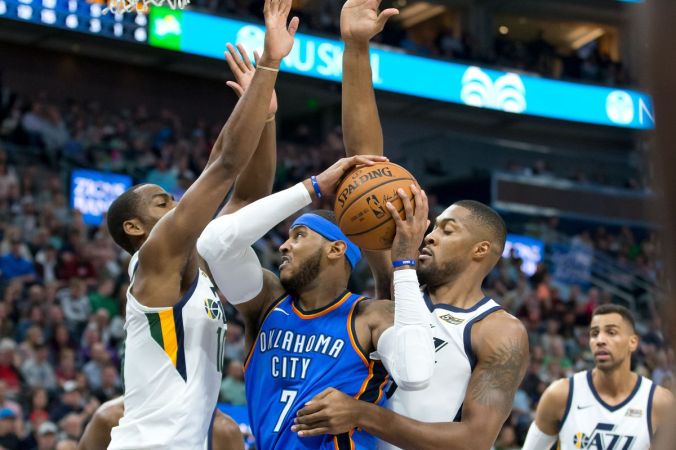
The Identity
For Jazz fans across the world, we know the identity of the Salt Lake Jazz is stitched in the cloth of defense. Dennis Lindsay and Co. brought in a coach that preached the D and then they gathered players who would implement it. For the organization, the philosophy has been ‘we’ll bring you in if you play defense. If you don’t, we’ll teach you. If you still won’t, it won’t work for us.’ In fact, for every free agency decision (Mr. Ingles), every trade idea (hello Crowder, goodbye Rodney Hood and Joe Johnson) every draft prospect (Mitchell was recognizing more for his defensive potential at first) and every development arc (Royce O’Neale, and, uh, hello Rudy Gobert), it’s about defense. You can look at the Jazz and say we don’t have the most athletic guys, or playmakers or scorers, but that’s OK. If you hustle, play hard, work together, and follow a sound scheme – all in regards to defense – then you are a Jazzman. That’s what Snyder wants, and gets.
Speaking to Salt Lake Tribune’s Tony Jones, Coach Snyder once said:
“Our defense has to become the staple in what we do. It takes time, and we’re focused on that. For us to be successful, we have to play on a string. We have to be solid on the ball. The guy on the ball has to be accountable, and if that doesn’t happen, the other guys have to have his back. This can’t just happen once. It has to happen throughout the possession. We have to be a unit.”
In the 2010s, the NBA has evolved and progressed towards points and scoring. You can point to LeBron James who anchored teams transitioning to space and pace as they surrounded LBJ with shooters and let them all play freestyle. The Golden State Warriors took that identity further and implemented shooters and shooting that the NBA hadn’t seen before. This year, Houston scores 113.5 a game with 42(!) three-point attempts a ball game. YouTube and HouseofHighlights are centered on isolation one-on-one plays and alley-oops and fast breaks and shooting streaks.
It’s all offense, all the time.
Except in Utah.
And sure, Utah does employ an isolation scorer and a (surprisngly) fast-paced offense, but they still are middle of the pack, or bottom of the pack, when it comes to offensive categories. Proof? 23rd in points per game, at 103.5/game. We are a modern-day, 2018 version Grit-N-Grind team where there may be games where scoring is secondary but the defense will always be the anchor.

The Numbers
If you were to take a pop quiz right now, with no extra tabs open and no Call-A-Friend feature, how many defensive categories would you guess the 2017-2018 Jazz rank in Top 10, Top 5? If you stroll onto stats.nba.com and organize it by the defensive and opponent numbers, this is what you’ll find, but let’s look at it in reverse, analyze it, and put it together like a puzzle.
Individual Category Style
- 4th in Defensive Rebound Percentage, at 79.8% and the leader is at 81.1%
- 3rd in Steals with 8.7 a game, while the leader is at 8.9
- 11th in Blocks at 5/game
This shows us that the Jazz are sound at the basics of basketball. After an opponent misses, the Jazz are quick to grab a rebound. When you have two mammoths down low in Derrick Favors and Gobert, plus rebounding guards like Ricky Rubio and Joe Ingles, you win this battle most nights.
This also shows us that the Jazz pressure ball handlers and cut off passing lanes. Rubio and Donovan Mitchell are wasps when it comes to harassing guards as they both rank Top 25 in steals per game this season. It helps to take risks and apply extra pressure knowing you have backup in the paint to cover your assets if you get beat or lose the gamble. It’s surprising the Jazz don’t rank higher for blocks a game, but Rudy did miss nearly 30 games. If he could qualify, he would rank third in blocks per game – at 2.4 a night. Let’s give Rudy *just* two blocks a game for *just* twenty extra games, and the Jazz would vault pass 400 blocks on the season and easily be Top 5.
The Opponent Numbers
- 3rd in Opponent’s 2nd Chance Points, only allowing 10.8/game
- 3rd in Opponent’s Fast Break Points, only allowing 9.7 a game (Detroit and Milwaukee are ahead with 9.6)
- 2nd in Points in the Paint, giving up 41.7 while the Grizzlies give up 41.6 points per game in the paint
- 1st in Opponent’s Assists at 20/game
- 7th in Opponent Turnovers, 14.9
In the category previous, we looked at how individual players made a defensive impact. Those players are part of a collective team, five guys glued to the same scheme working for the same result. If you put those five in sync, you get your opponents to do things listed in this category. Sure, Rubio is a thief and Gobert is the anchor, but when incorporated into the larger unit, the defense, on the whole, becomes suffocating.
As a five-man body, the Jazz halt ball movement, resulting in turnovers, end of shot clock situations, hero ball, or one on one attempts. These aren’t usually made baskets, and, remember, the Jazz are good at rebounding. Since the team rebounds well, opposing teams are then rarely getting second-chance opportunities. Do you think the Jazz practice defensive rebounding? Is that a stat that is hounded on and doctrinilized? You better believe it. Knowing the bigs do their job down low, the guards force teams off the three-point line and dare them to infiltrate the paint. The paint is a no-fly zone, resulting in tough buckets. Snyder coaches no easy baskets, so another staple of Jazz defense is to foul in fast-break situations which prevent easy twos. Teams are then forced to take the ball out of bounds and run a half-court set. The problem is, the Jazz have now set up their halfcourt defense and, spoiler alert, it isn’t pretty.
The Opponent Shooting Number
- 3rd in Opponents Field Goal Made, 37.4, and Field Goal Attempts, 82.9
- 6th for Opponent Field Goal Percentage where they shoot 45.1% vs Utah
- 6th in Opponent Threes Made a game, only allowing 9.6 in 26.4 attempts (good for 4th in the league in attempts)
- 8th in Free Throw Makes and Attempts, 15.8 in 20.5 attempts
Oh man, that @utahjazz defense
Yikes.#takenote https://t.co/ZLVaz0MgFF— Nate Dubs (@natedub9) March 26, 2018
https://platform.twitter.com/widgets.js
How has your favorite NBA team fared on both ends of the floor since the All-Star break? pic.twitter.com/DHXNKe03Z4
— NBA Math (@NBA_Math) March 26, 2018
https://platform.twitter.com/widgets.js
When you put all these individual and group-based stats together, you realize how tough it would be to score against this Utah Jazz group. That’s where these numbers come in, again, proving our analysis.
Opponents, either at Vivint or their home floor, struggle to get shots off or to get shots to drop. It doesn’t matter if it is in the paint, the midrange, from deep, or even a free throw. The Jazz make you work, you take a lot of time and effort to get there, and, usually by the fourth quarter, you are burned out, tired, or ready to clothesline Rubio.
Think specifically about the free throw average. Not only do the Jazz play tough defense to make life difficult, they also play sound defense. To me, the free throw numbers suggest that the Jazz are not only capable defenders athletically but have practiced and perfected their art for minimal deficiencies. Foul shots are easy points to give up and the Jazz have internalized the idea to not give up gimmies. It’s a skill to not foul, a habit created, perhaps even part of the Utah Jazz culture.
The Big Numbers
- 3rd in the NBA in Defensive Rating, at 102, behind Boston (101.3) and San Antonio (101.9)
- 2nd in Opponent Points, giving up 100.2 a night (13 points less than the Suns who are the worst in this category
Here’s a look at the #UtahJazz #defense over most of the last 18-19 wins. #TAKENOTE pic.twitter.com/fWwRlwSmvt
— brettm73 ?⭐ / ?? (@brettm73) March 14, 2018
https://platform.twitter.com/widgets.js
OK, first, this blows my mind: In the 24 games since Feb. 2, where the Jazz are 20-4, they’ve held their opponents under 100 points 19 times. Again, in the modern NBA of points galore, this is amazing.
The 12 stats listed before our big numbers validate the Jazz’s ranking as one of the best, top three, defensive teams in the NBA. How many points a team scores a night tell us this is true, or an advanced stat like the Defensive Rating justifies the opinion as well. The Jazz are good because they play defense and the defense is better than good.
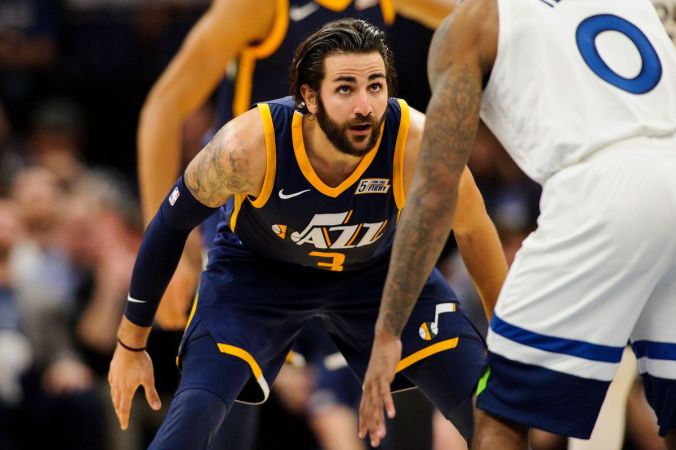
Stats Don’t Lie
Defense wins championships.
While that title certainly isn’t coming true this year, the point is indeed valid. For our season and our argument, defense wins games, secures playoff positioning, and provides the recipe to playoff success. It may not make Sportscenter montage (unless Rudy brings back the salute), but it does promise for success as defense can travel to away arenas and play against multiple styles. If the Jazz have a religion, they are worshipping at the feet of D.
 Steve Godfrey Writes