ICYMI: With the season now in the rear-view mirror, it’s time to reflect on one of the best seasons in recent memory. I say thank you here.
Article updated on 5/09/17
About a month ago I decided to follow a new twitter account. They had a catchy handle. They had a nice profile and banner picture. They had a good cause.
And they had a billboard.
Jazz fans, share this like crazy. Let’s get this billboard up and convince Hayward to stay in Utah. #TakeNotehttps://t.co/GtrptMTVPo
— Stayward (@UtahJazz6Man) April 5, 2017
//platform.twitter.com/widgets.js
@UtahJazz6Man has declared their profile to “campaign to commission a billboard in hopes of helping Hayward make the decision to remain in Utah.” It’s also noted that “Fan page not officially associated with the Jazz.” Oh, and the hashtag: #Stayward
I think Jazz fans want to feel like they have a say in free agency, as if they did all they could to keep him hear. We’ll cheer our hearts out, buy his jersey, and mimic his hairstyle, but we crave more control in the process. On paper, I like the billboard idea. And the best thing about it: it worked. The cause raised more than the $5,000 needed, with the man behind it all saying it would go up soon after the playoffs ended. Check out the gofundme page for more details, to donate, or just updates.
A reminder that The Jazz asked me to wait until after the playoffs but it’s still happening. We’ll all be happy with the result. Go Jazz!
— Stayward (@UtahJazz6Man) May 6, 2017
//platform.twitter.com/widgets.js
Regardless of back-seat-alphabet-game-reading-material-on-road-trips, Hayward should already feel and know that Jazz fans love him and want him to stay. I hope he sees that free fall it would cause if he left. I hope he heard chants to end the regular season and to end the playoffs. I hope he wants to stay, regardless of billboards.
Plus, the reasons for staying are on the court, not next to the highway. Here are the three biggest reasons Hayward should stay, from a basketball perspective.
The Gobert Factor

Rudy’s got your back, G.
During games, Bolerjack and Harpring are quick to point out the Gobert Effect when opposing players get near the rim, miss, or pass and dribble back out. He doesn’t block the shot, but he certainly alters the play. Likewise, his play should influence Hayward’s decision.
Name a better complement to Hayward’s game than Gobert. Hayward wants to score and handle the ball, Gobert doesn’t take that away from him. In order to score or play clean ball, Hayward wants it easy. Who better to set hard screens, clear out lanes, catch lobs, or pound the offensive board? Hayward wants a lighter load on the other side of the ball too, Gobert is right behind him to clean up any mess.
With Rudy as your starting center, Hayward knows the team will defend which means the team will contend. Hayward was an All-Star and Rudy is blossoming into a star. Their skill sets are different, but piece together perfectly for team basketball. In the era of Big Three and Super-Teams, a Hayward and Gobert combination is actually seamless and mesh to let each thrive without having to sacrifice their own game.
And to top it off, Gobert exudes confidence. When asked what he would say to entice Hayward to stay, Gobert simply replied, “I’m just going to ask him, Do you want to win a championship?” He adds, “We’ve improved the last few years…I don’t think it’d be a great decision to leave now.”
Quin
Don’t get me started about Brad Stevens and the bromance in Boston. Quin is the coach for G.
Stevens and Hayward had a good run at Butler, but they were only together two years for a total of 69 games. Plus, it’s been nearly ten years since Hayward walked the court as a freshman bulldog. Since then, Hayward has matured on and off the court.
Quin has been with Hayward longer, for more games, and recently which is really key. What’s current is what’s good. Things are moving in the right direction under this Snyder head coach and the relationship between the two are positive. Like Stevens, Snyder is a young, energetic head coach who is rising the ranks among NBA circles as a smart, intuitive, innovate head coach. Unlike Stevens, Quin also has great hair.
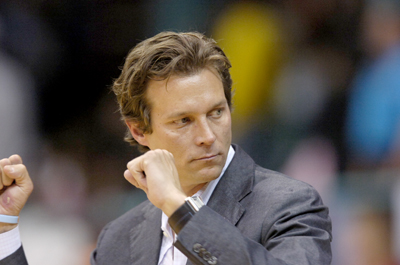
Hayward and Snyder share stylists.
The System
But on top of that, the system installed by this coaching staff has been designed around Hayward as the top gun. Quin has evolved and adapted plays and play style to fit Hayward. How many late-game sets are focused on Hayward? How many Out-Of-Timeout situations get G an easy bucket? How much time does Hayward touch the ball, get the feel of the game, and make plays? All of that is by design.
He’s also gotten better each year, and each month throughout the year, which is also by design.
While any coach would adapt around a star like Hayward, they won’t drift from their originally designed theories which cater around stars, like Isaiah Thomas and Al Horford in Boston. Hayward is a top-five NBA small forward, which means he’d be an upgrade to most any teams need at that position. But, going to a new place means a new system and sometimes new isn’t better.
Hayward has seen individual and team success while in Utah, all by design which centers around him. Keep that going, and it’s only up and up.
The Counter-Claim: To Compete
Competing for a championship is what Hayward has said is his top priority. When making free agency decisions, he’ll decide based on what gives him the best position to succeed. All stars say this, and I believe most stars mean this. Hayward is one of those guys who wants to be a winner.
He has taking the steps necessary to improve his game and become better. He’s getting recognized nationally as this has happened, but he still seems centered on winning and the betterment of the team. If Hayward wants to be in position to win every night and compete late in May and June, he needs to stay in Utah.
Why? The Jazz have young talent, smart management, a style that can sustain success, and a fan base who is desperate for it.
But back to Boston, they can argue the same can’t they? Of course. Boston has an easier path in the Eastern Conference, draft picks to build up young talent, a defensive scheme that is working, a very talented roster, and a hole at small forward where Hayward would be an obvious upgrade. With or without Hayward, Boston could easily be in the Eastern Conference Championships for the next five years. With a couple breaks, and certainly with Hayward, Boston could be in title contention.
As a Jazz fan, I want to stay blind and ignore that whole previous paragraph. I want to be naiive and think Utah is in far better position to compete than Boston. But as an objective NBA fan, that’s a tough pill to swallow.
Hayward said all the right things during his exit interview, noting that he hasn’t thought much about free agency, but also that he will keep his options open since it’s a rare time in his life that he can do so. That’s fair, and certainly his right. He also pointed out that he has “nothing but love for Utah (and the community)” while acknowledging his growth as a basketball player and as a man occurred in Utah. He talked about free agency with a smile on his face, putting up with different forms of the same question. In all sincerity, he has loved his time in Utah and with this team, especially this year.
Throughout other exit interviews, other players were quick to point out how much Hayward loves it here. George Hill said that Hayward’s “heart is in Utah” and Joe Ingles agreeed. Joe Johnson (not so subtly) pointed out that this team would be a force to reckon with, if everyone returns. It’s clear: they all want to come back and play hard, if G is back, too.
In Hayward’s mind, does he want to go East Coast or stay in Utah? Does Mrs. Hayward love her current life, lifestyle, and home or could she be ready for a change? Does Hayward want to be the team star and keep up the stats or be the 2nd best, or 3rd best, piece on a team? And ultimately, where can Hayward compete for a ring on a yearly basis?
Those are quite the questions, and ones I’m glad I don’t have to make. All I hope is that a billboard helps Stayward.
(Thanks for visiting The Tortured Fan! If you like what you’re reading, follow me on Twitter @JazzJunkie12 or go like The Tortured Fan Facebook page. Go Jazz!)
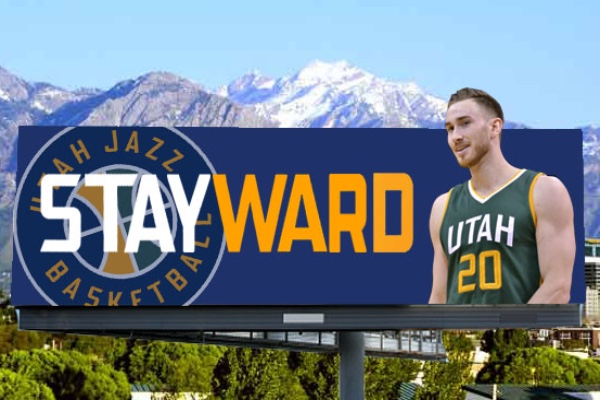
Carry on my Hayward son.
 Steve Godfrey Writes